Which Louisiana Duck Zone Am I In?
Louisiana has two duck zones, East and West. The line runs down LA 79 from the Arkansas border to Homer, LA 9 to Arcadia, LA 147 to Hodge, US 167 to Lafayette, then US 90 to the Mississippi line. The West Zone is everything west of that route plus the coast below US 90. The state kept this same line for the 2026-30 seasons.
TLDR:
- Two zones: East and West, with up to two splits each.
- The line: LA 79, LA 9, LA 147, US 167 and US 90.
- Most of the coast is West Zone: everything below US 90 to the Mississippi line.
- Not new: the same line has been in place since the 2021-22 season.
- Kept through 2029-30: adopted again in August 2025 after a hunter survey.
- 2026-27 openers: West Zone Nov 14, East Zone Nov 21.
Your zone sets your opening day, your closing day and your youth hunt. For a lot of Louisiana hunters the answer is obvious. If your lease sits near Lafayette or the US 167 corridor, it is worth reading the line one highway at a time.
Know your zone, then gear up. West Zone opens Nov 14. The SDO rope hat is a one-size, 5-panel cap with a woven patch, made for the job and the blind.
Louisiana Duck Zones Map: Where the Line Runs
LDWF’s official zone map is in the commission’s 2026-30 release; the diagram below traces the same route. The line follows state and federal highways from north to south. It does not follow parish lines, which is why some parishes sit on both sides of it.
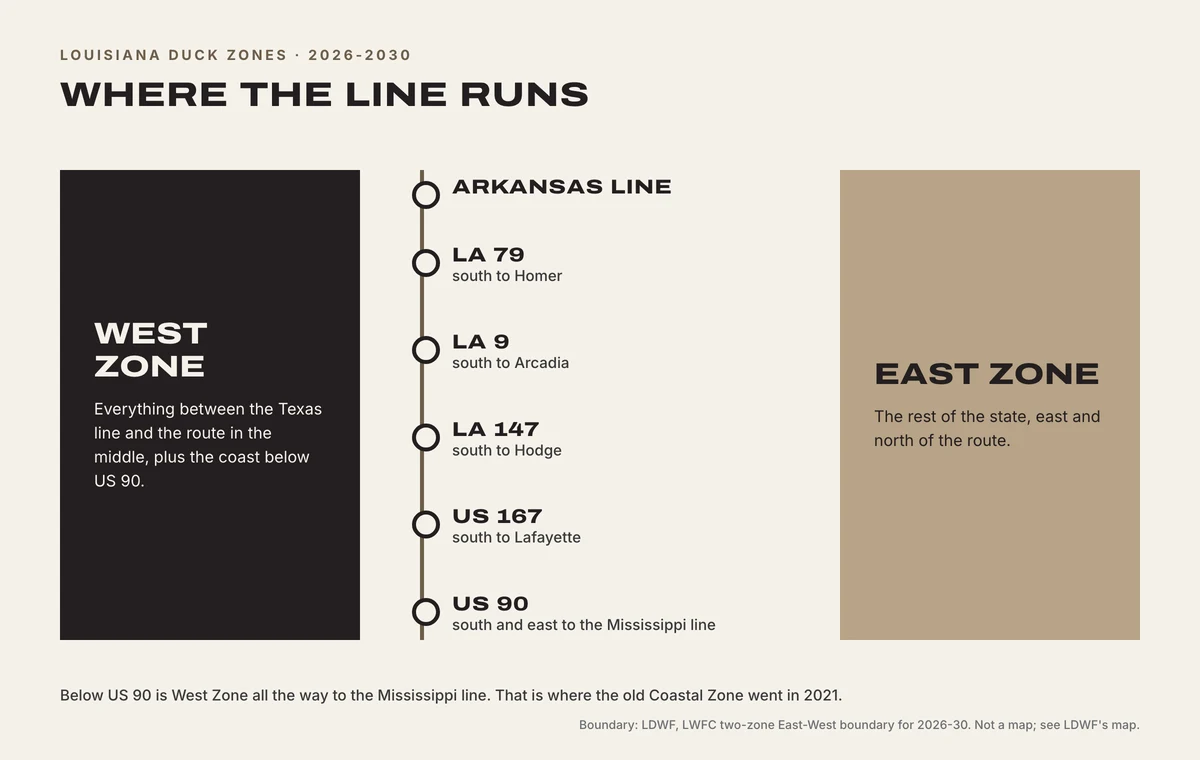
Per the boundary LDWF adopted for 2026-30, as reprinted by the Houma Times, the West Zone is the part of the state between the Texas line and this route:
- South on LA 79 from the Arkansas border to Homer.
- South on LA 9 to Arcadia.
- South on LA 147 to Hodge.
- South on US 167 to Lafayette.
- South and east on US 90 to the Mississippi state line.
The East Zone is the rest of the state. LDWF publishes a zone map with the commission’s 2026-30 decision; use it for any property close to the route.
Why the Coast Is West Zone
The last leg of the line is the one to read twice. From Lafayette, the boundary follows US 90 south and east all the way to the Mississippi line.
That puts the land south of US 90, which is most of the coast, in the West Zone, including the southeast marsh below New Orleans. A hunter in that southeast marsh follows West Zone dates, even though it sits on the east side of the state.
It works that way because of how the commission redrew the zones in 2020 for the 2021-22 season, which is the next part of the story.
From Three Zones to Two
Louisiana did not always run two zones. Through the 2020-21 season, the state used three: East, West and Coastal, with one split each.
For the 2021-22 through 2025-26 seasons, the commission moved to two zones with up to two splits.
Per the LDWF release on the 2021-25 zones, the new West Zone combined the old West and Coastal zones plus part of the rice country in southwest Louisiana. The decision drew on the 2020 Louisiana Waterfowl Hunter Survey and 20 years of federal harvest data.
The Daily Iberian described the change in 2021 as a return to two zones, and a move from one split to two splits, or three season segments.
Why Louisiana Kept Two Zones Through 2030
States lock in their zones and splits for five seasons at a time. In August 2025, the Louisiana Wildlife and Fisheries Commission voted to keep the same two-zone line for 2026-27 through 2029-30.
The commission adopted the zones after weighing hunter preferences from the 2025 Louisiana Waterfowl Hunter Survey.
Per Louisiana Sportsman’s report on the vote, the department emailed the survey to 66,651 HIP-registered hunters, about 11,000 responded, and 8,952 responses went into the analysis.
Hunters who answered were largely satisfied with the zones and less happy with the opening and closing dates. Commissioner Johnathan Walker put it this way in the same report: “Because the survey results were so overwhelmingly in favor of keeping the current zones, I think we can make more of an impact by alternating the dates each year rather than changing the zones.”
Not everyone agreed. The report also notes a hunter who argued the survey reached too few people.
How Federal Rules Shape the Zones
Louisiana picks its zones from a short federal menu. The choice between two and three zones is really a choice about how many splits hunters get.
Per federal regulation 50 CFR 20.115, states choose one of these duck season setups for each five-year period:
| Zones | Season segments allowed |
|---|---|
| One zone | Up to 3 segments (2 splits) |
| Two zones | Up to 2 segments in each zone |
| Two zones | Up to 3 segments in each zone |
| Three zones | Up to 2 segments in each zone |
| Four zones | One continuous season in each zone |
Louisiana uses two zones with up to three segments; for 2026-27, each zone uses two segments with one split.
Commissioner Walker made the same point in the 2025 vote coverage: with three zones, USFWS would allow only one split, while two zones give the commission more room to move dates.
Plan the opener, not just the zone. Our season guide has every 2026-27 date, the bag limits and shooting hours in one place.
What the Zones Mean for 2026-27
Both zones get 60 days of regular duck hunting. The difference is where those days fall.
Per LDWF’s 2026-27 hunting schedule, the West Zone opens Nov 14 and runs to Dec 6, then Dec 19 to Jan 24.
The East Zone opens Nov 21 and runs to Dec 6, then Dec 19 to Jan 31. The West Zone gets more November days; the East Zone gets a longer run in January. A lease just east of US 167 north of Lafayette, for example, follows East Zone dates.
Youth and veterans days follow the zones too: Nov 7 and Jan 30 in the West, Nov 14 and Feb 6 in the East. The full calendar is in our 2026-27 Louisiana duck season guide.
Hunting Near the Line
Most hunters never think about the boundary. If your land or your blind is close to one of the five highways, a little homework saves a ticket.
LDWF does not publish a parish-by-parish zone list, and because the line follows highways, some parishes land on both sides.
Check the exact route against LDWF’s map for any lease or public area near LA 79, LA 9, LA 147, US 167 or US 90. When in doubt, call LDWF before opening day rather than after. Carry the right paperwork too; our Louisiana duck license and HIP guide covers what goes in the blind bag.
What Hunters Ask About Louisiana’s Duck Zones
These come up every year, usually right after the schedule posts. Short answers below.
What are the duck zones in Louisiana?
Louisiana has two duck zones, East and West. The West Zone runs from the Texas line to a highway route of LA 79, LA 9, LA 147, US 167 and US 90, and it includes the coast below US 90. The East Zone is the rest of the state. The same zones apply through the 2029-30 season.
Are the Louisiana duck zones new for 2026?
No. The East and West zones have been in place since the 2021-22 season, when Louisiana dropped its separate Coastal Zone. In August 2025, the commission voted to keep the same two zones for the 2026-27 through 2029-30 seasons after a statewide hunter survey.
Is the Louisiana coast in the East or West Zone?
The land below US 90 is in the West Zone, all the way to the Mississippi line. That covers most of the coast, including the southeast marsh below New Orleans. Coastal land north of US 90 falls in the East Zone, so check LDWF’s map near the highway.
When does each Louisiana duck zone open in 2026-27?
The West Zone opens Saturday, Nov 14, 2026 and the East Zone opens Saturday, Nov 21, 2026. Youth and veterans hunt a week earlier in each zone: Nov 7 in the West and Nov 14 in the East, with a second day on Jan 30 (West) and Feb 6 (East). Both zones are closed Dec 7 through Dec 18.
Why does Louisiana use two zones instead of three?
Federal rules allow only one split with three zones, while two zones can have up to two splits each. The commission kept two zones for 2026-30 after weighing the 2025 Louisiana Waterfowl Hunter Survey, where respondents were largely satisfied with the current zones.
Zone boundary as published in LDWF’s 2026-30 decision, via news reprints. Always confirm with LDWF’s seasons and regulations page before you hunt.
No guesswork on opening morning. Know your zone, check the map and bring a hat that can handle a wet dog and a long boat ride. Questions about an order? Call us.
Share